



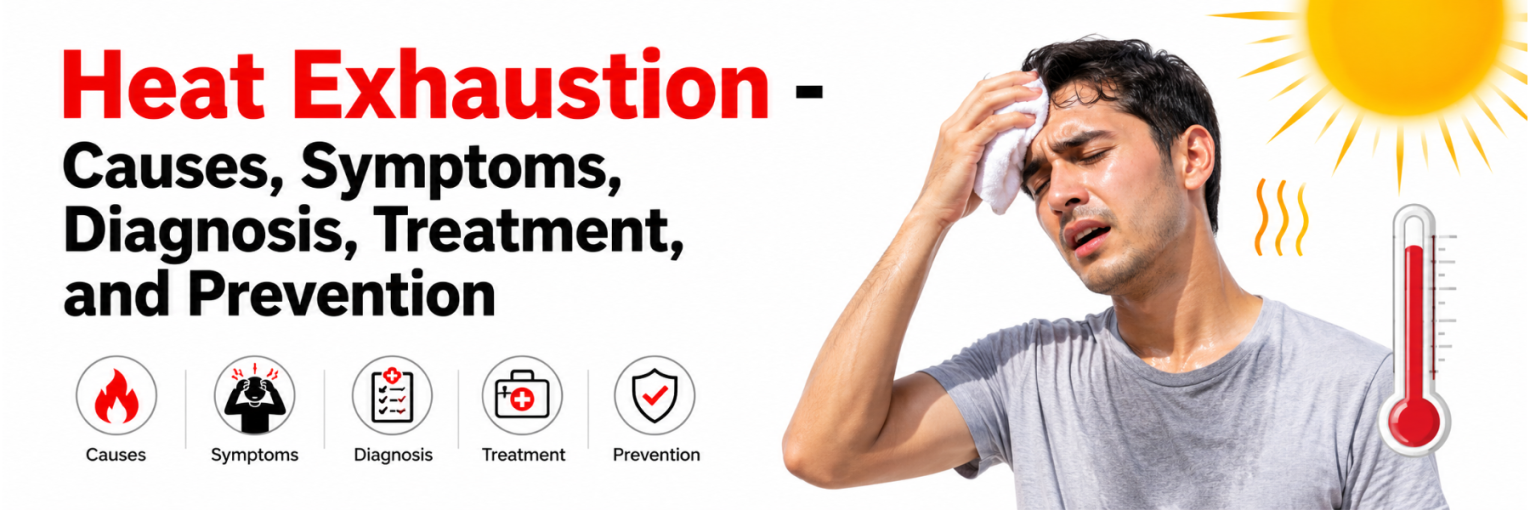
Heat exhaustion is one of the most common heat-related illnesses, and it usually begins more quietly than people expect. A person may feel tired, slightly dizzy, or more drained than usual and assume it is nothing serious, and that is exactly why it gets ignored.
It usually happens when the body loses too much fluid and salt after long exposure to heat, heavy sweating, outdoor work, poor hydration, or time spent in a hot and poorly ventilated place. These are some of the most common causes of body heat imbalance. When fluid loss keeps building, and the body cannot cool itself properly, the body begins to struggle to regulate temperature effectively.
Early Phase
The early phase can look deceptively mild. Heat exhaustion symptoms often include weakness, headache, nausea, muscle cramps, heavy sweating, light-headedness, and unusual tiredness. Some people also feel shaky or faint. If these signs of heat exhaustion are ignored, the condition can get worse and may move toward heatstroke. That is why it helps to know what you are looking at.
- Heat exhaustion needs fast cooling, rest, and fluids.
- Heatstroke is more dangerous and needs urgent medical help.
The following paragraphs cover the signs of heat exhaustion, the signs of heat stroke, the first steps to take, and when a doctor may advise further evaluation.
Heat Exhaustion vs Heatstroke: Knowing the Difference
Heat exhaustion happens when the body is still trying to cool itself but is struggling to keep up. Too much sweating causes loss of water and important salts, and the person starts feeling unwell. In many cases, the skin feels cool, damp, or clammy.
- Common heat exhaustion symptoms include heavy sweating, thirst, headache, cramps, nausea, tiredness, a rapid pulse, and feeling faint on standing.
- The signs of heat exhaustion often appear before collapse. Someone may look pale, stop tolerating activity, or say they suddenly feel “off” in a way that is hard to explain.
- Heatstroke occurs when the body’s core temperature rises significantly, often above 40°C (104°F), along with nervous system dysfunction.
- The signs of heat stroke can include confusion, agitation, poor coordination, slurred speech, fainting, seizures, or reduced consciousness.
- Heatstroke symptoms may also include very hot skin, a racing pulse, and high body temperature. Sweating may still be present, so that point alone should not guide the diagnosis.
How They Differ
A simple way to think about it is this: heat exhaustion mainly reflects fluid and salt loss with rising heat stress, while heatstroke means severe overheating is now affecting the brain and other organs.
- If a person becomes confused, unusually sleepy, hard to wake, or starts behaving oddly in the heat, that should be treated as an emergency.
- People often ask why clammy skin is more typical of heat exhaustion. The reason is that the body is usually still sweating actively, which leaves the skin cool, wet, and sticky.
- In heatstroke, the bigger concern is not the skin texture. It is the person’s mental state, body temperature, and overall condition.
- Pulse can also be misleading. A fast pulse can happen in both conditions. There is no practical value in trying to separate a “heat pulse” from a “stroke pulse.”
- It is much better to look at the full picture: alertness, weakness, temperature, and whether the person improves once cooling starts.
Primary Causes and Risk Factors During High Temperatures
Most heat-related illnesses develop because several things happen at the same time. There is heat exposure, there is fluid loss, and there is a point where the body can no longer cool itself well enough. That combination drives heat stress and makes symptoms appear.
- Sweating is one of the body’s main cooling tools. Blood flow also shifts toward the skin so heat can escape.
- When the weather is very hot, the air is humid, or a person is not replacing lost fluids, that system becomes less effective. The result is faster fatigue, poorer temperature control, and a higher chance of heat exhaustion symptoms.
- It is also worth remembering that heat exhaustion does not always happen outdoors. It can happen inside homes, offices, kitchens, factories, and other enclosed spaces if ventilation is poor and heat builds over time. During a heat wave, indoor exposure can be enough.
- Another reason people get into trouble is delay. They feel tired, keep working, and assume they will rest later. By the time nausea, cramps, weakness, or dizziness show up clearly, the body may already be under strain.
Good heat stress prevention is usually simple. Drink water regularly, and rest in the shade when possible. Wear loose and breathable clothing, and avoid the hottest part of the day if you can. Use fans, cool cloths, or air-conditioned spaces early. Small steps taken at the right time can prevent a much bigger problem later.
Immediate First Aid and Treatment Steps for Heat Exhaustion
The first rule is to get the person out of the heat; that alone makes a difference. Move them to a shaded area, a cool room, or any place with good airflow. The body cannot recover properly if the heat exposure is still going on.
- Once they are in a cooler place, let them sit or lie down.
- Remove extra layers and loosen anything tight around the neck, waist, or chest.
- Start cooling the body with simple methods such as cool wet cloths, fanning, cool water on the skin, or cold packs placed over the neck, underarms, and groin.
- If the person is awake, alert, and able to swallow, give fluids slowly. Water may be enough in milder cases.
- If there has been a lot of sweating or the person has cramps and marked weakness, oral rehydration fluids may help more because they replace both water and salts.
- Slow sips are usually better tolerated than drinking too much too quickly.
Treatment for heat-related illness does not end the minute the person says they feel better. Keep watching them; some people recover quickly. Others stay weak, dizzy, or nauseated for a while.
Get emergency help right away if these appear:
- Confusion or unusual behaviour.
- Fainting or repeated collapse.
- Seizures.
- Inability to drink.
- Repeated vomiting.
- A very hot body with reduced alertness.
- Severe weakness that does not improve.
- Chest pain or shortness of breath.
Treatment
Sunstroke treatment, or treatment for suspected heatstroke, is much more urgent than routine home care. In that situation, the priority is rapid cooling and immediate medical attention. Delay can raise the risk of complications involving the brain, kidneys, heart, muscles, and circulation.
- People often ask why blood pressure seems to drop so sharply during heat exhaustion. The answer is fairly simple. The body loses fluid through sweat, and at the same time, blood vessels widen near the skin to release heat.
- The combination reduces effective circulating volume, especially when the person stands. The result may be dizziness, blurred vision, faintness, or a feeling of almost blacking out.
- Symptoms can also return later. Someone may improve after cooling down, then feel weak or dizzy again a few hours later.
- That often happens because dehydration or salt loss has not been fully corrected. Rest, fluids, and continued observation still matter, even after the first round of improvement.
How Doctors Diagnose Heat-Induced Physiological Stress
When a patient comes in after a heat-related episode, doctors do not rely on one sign alone. They look at the whole situation. They will usually ask how long the person was exposed to heat, what kind of activity they were doing, how much they drank, whether they were sweating heavily, and whether fainting, vomiting, or confusion occurred.
- Vital signs are checked early. Doctors look at temperature, pulse, blood pressure, breathing rate, and mental alertness.
- A person with heat exhaustion may show low blood pressure, rapid pulse, cramps, weakness, or dehydration-related symptoms.
- If the patient is drowsy, confused, disoriented, or collapsing, the concern shifts more toward heatstroke or another serious cause.
- Shifts in fluid and salt balance are common in heat-related illness, and they can delay recovery if left unrecognised.
- In moderate cases, lab tests can be useful. An electrolytes test may be advised to check sodium, potassium, and related values.
- Doctors may also evaluate kidney function or other blood markers when the episode looks more severe. That becomes more important if weakness is ongoing, blood pressure remains low, urination drops, or the patient is not improving as expected.
Myths And Critical Temperature Window
A common myth is that heat illness can be judged by temperature alone. That is not correct. Some patients are partially cooled by the time they are examined, so the thermometer may not tell the whole story. Diagnosis depends on symptoms, history, hydration status, mental state, and overall clinical condition.
- People also ask about a “critical temperature window” for heat exhaustion. There is no single cut-off that works for everyone.
- One person may become quite unwell before the temperature appears extreme, while another may tolerate heat differently.
- That is why early heat exhaustion symptoms should be taken seriously, even before a dramatic rise in body temperature is seen.
- In severe heatstroke, rapid cooling becomes urgent. Emergency teams may use intensive cooling methods under supervision.
- Ice-water immersion is one recognised option in selected cases when very fast temperature reduction is needed. The exact method depends on the patient, the setting, and the treating team.
Heat Stress Diagnostic Support at Vijaya Diagnostics
When a doctor recommends testing after a significant heat-related episode, dependable diagnostic support can make the next steps clearer. At Vijaya Diagnostics, patients can access doctor-advised investigations, such as an electrolytes test, when dehydration, salt imbalance, or ongoing heat stress needs to be assessed.
That kind of support matters because heat-related symptoms can overlap with several other problems. Weakness, dizziness, low blood pressure, and fatigue may be linked to dehydration, infection, metabolic disturbance, or another underlying issue. Proper testing helps the doctor sort that out more confidently.
Vijaya Diagnostics is supported by recognised accreditations and quality systems, including NABL, NABH, and ISO 9001:2015 certification. The organisation also brings more than 40 years of experience in diagnostic services, more than 100 million lives touched, and a network of 200 centres with advanced facilities and strong customer care.
FAQs
Why does blood pressure often “crash” during heat exhaustion?
Blood pressure can fall because the body is losing fluid through sweat while also sending more blood toward the skin to release heat. That reduces the amount of effective circulating volume, especially when standing. The person may then feel dizzy, faint, or close to collapsing.
What is the “Critical Temperature Window” for heat exhaustion?
There is no single fixed temperature that defines the danger point for everyone. Heat exhaustion is usually recognised through symptoms, fluid loss, and the person’s overall condition rather than one number on a thermometer. Early weakness, heavy sweating, cramps, nausea, and dizziness should all be taken seriously.
How can you tell the difference between a “Heat Pulse” and a “Stroke Pulse”?
You really cannot depend on pulse alone. A rapid pulse can happen in both heat exhaustion and heatstroke. It is more useful to look at the full picture, including body temperature, mental state, sweating pattern, and how sick the person seems overall.
Why is “clammy skin” a hallmark of exhaustion but not stroke?
In heat exhaustion, the body is usually still sweating heavily, so the skin often feels cool, damp, and clammy. In heatstroke, the more important warning signs are severe overheating and altered mental status. Skin feel alone does not define the condition.
How does “Humidity” change the risk of heat exhaustion?
Humidity makes it harder for sweat to evaporate. Since evaporation is how sweat cools the body, high humidity reduces cooling and allows heat stress to build faster. That is why hot and humid weather often feels much more draining.
What is the “Ice-Water Immersion” priority?
In severe suspected heatstroke, rapid cooling remains a medical priority. Ice-water immersion may be used in selected emergency settings under supervision when very fast cooling is needed. The exact approach depends on the patient’s condition and the available medical support.
Can “Secondary Dehydration” occur hours after cooling down?
A person may feel better after initial cooling but still have ongoing fluid and salt loss. If weakness, cramps, or unusual tiredness return later, dehydration or electrolyte imbalance may still be present.